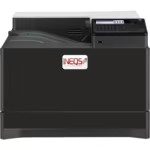
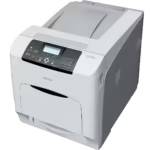
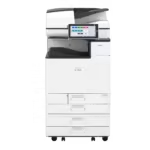
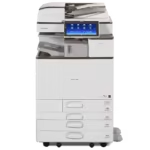
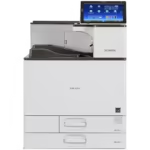
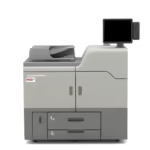
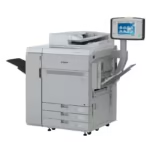
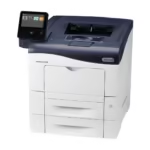
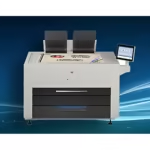




A ceramic printer and its toner are a ten-year relationship. The printer needs developer, drums and profiles; the toner needs to fire the same way in 2036 as it does today. Before you sign, ask these six questions. They are the ones we would ask.
1. Who formulates and manufactures the toner?
Many printer suppliers sell toner made by someone else, sometimes under their own name. That is not wrong, but it means colour problems get passed along a chain. Ask to see where the toner is made. INEQS formulates and produces its ceramic toners and its covercoats in its own factories, with a chemical engineer on staff.
2. Who converts the printer, and do they also make the toner?
A conversion designed by the same engineers who formulate the toner behaves differently from a conversion bought in. Fuser temperature, developer charge and paper path are tuned to the toner, not to an office toner and then hoped for. INEQS designs its own conversions and its own industrial printers.
3. Can you visit the factory?
If the answer is complicated, there may not be one. INEQS is less than an hour from Frankfurt airport; bring a file and your own ware and leave with a fired sample.
4. Will they fire a sample on your ware before you buy?
Every glaze and kiln is different. A supplier who tests your tile, your porcelain or your glass before quoting is a supplier who has seen the problems before. INEQS prints, fires and returns test pieces for new customers.
5. Are the firing ranges in writing?
Ask for the firing range of every toner set and the coating options for each, on paper. Vague answers become your problem after delivery. INEQS publishes its ranges: unfluxed 860 to 1,150 °C, fluxed 805 to 900 °C, glass 540 to 630 °C and supplies a curve with every set.
6. Who answers the phone in year three?
Ask what happens when density drifts or a fuser fails: who diagnoses it, how fast, and whether developer and parts are in stock. INEQS technical service is Monday to Friday, 08:00 to 17:00 CET, and over 80% of problems are solved within one working day.
Things that sound important but are not
- “Patented toner.” The original ceramic toner patents expired or were revoked more than a decade ago. Ask about formulation instead.
- Company size. Headcount tells you little about who will fix your printer. Ask who, by name, does the technical support.
- Brand-name printers. Every supplier converts Ricoh, Canon or Xerox engines. The conversion and the toner are the product, not the badge.
| Question | INEQS |
|---|---|
| Makes its own toner | Yes |
| Makes its own covercoat | Yes |
| Designs its own printer conversions | Yes |
| Builds industrial direct printers | Yes |
| Factory visits | Yes, by appointment |
| Fired sample before purchase | Yes |
| Firing ranges published | Yes |
| Technical service | Mon to Fri 08:00 to 17:00 CET, worldwide |