

Terms you will meet on this site and in conversations with INEQS engineers.
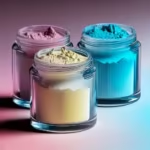
Ceramic toner
Dry toner for laser printers in which the colourant is an inorganic ceramic pigment rather than a dye. Fired into a ceramic, enamel or glass surface it becomes permanent.
Covercoat
A clear layer applied over a printed decal, by lamination, screen or spray, that holds the image together during transfer and burns out or fuses in the kiln.
Decal (waterslide transfer)
A printed image on gummed paper. Soaked in water, the image layer slides off the paper onto the ware.
Developer
The carrier particles in a laser printer that charge and transport toner to the drum. Ceramic printing uses a developer matched to each toner family; it wears and is replaced.
Direct printing
Ceramic inkjet printing straight onto the substrate on a production line, without a decal.
Firing curve
The temperature and time programme for a kiln: heating rate, ventilation phase, peak and hold.
Flux
A glass frit that melts at firing temperature and bonds pigment to the surface. Fluxed toner contains it; unfluxed toner relies on the glaze.
Gamut
The range of colours a set can reproduce after firing. Ceramic gamuts are narrower than print gamuts, especially in red and green.
ICC profile
A colour management file describing how a specific printer, toner set and paper reproduce colour, so screen and fired result match.
In-glaze
Decoration fired hot enough for the glaze to soften and absorb the pigment. Most durable; used for tile and tableware.
Onglaze
Decoration fired on top of an already fired glaze at lower temperature. Requires fluxed toner.
Lacquer
A coating for fluxed toner decals that burns out completely and leaves no visible edge.
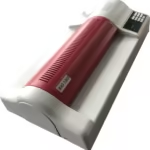
Laminating paper
Covercoat supplied as a sheet, applied to the printed decal with a hot laminator.
Precoated decal paper
Decal paper already carrying a covercoat, so the separate coating step is skipped.
RIP
Raster image processor. Software that prepares files for the printer: colour conversion, nesting, tiling of large images.
Sticker effect
A visible step at the edge of a decal after firing with a fluxed covercoat. Avoided by full-area coating or lacquer.
Substrate
The material being decorated: tile, porcelain, stoneware, enamel steel, glass.
Unfluxed toner
Ceramic toner without frit, fired in-glaze at 860 to 1,150 °C.
Fluxed toner
Ceramic toner with frit, fired onglaze, on enamel or on glass at 550 to 900 °C.
White toner
Fluxed white ceramic toner for text and marks on dark ware; standard sets print white as transparent.