


Short answers from the INEQS technical team. If your question is not here, email info@ineqs.com and it will probably be here next month.
Questions people ask
What is digital ceramic printing?
Decorating ceramic, glass or enamel by printing the design onto waterslide decal paper with a converted laser printer and ceramic toner, transferring it to the product and firing it. The colour fuses into the surface and lasts as long as the product. How it works, step by step.
What are ceramic decals?
Printed images on waterslide paper that transfer onto ceramic, porcelain, glass or enamel. After firing, the decoration is part of the surface and resists weather, UV light, heat and cleaning agents.
Why choose digital printing instead of screen printing?
Digital printing gives full colour, photographs and one-off designs with no screens, films or setup cost. It suits short runs, custom work, prototypes and on-demand production. For long runs of a single identical design, screen printing is usually still cheaper.
What can be decorated with ceramic toner?
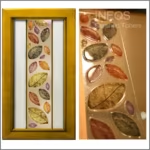
Porcelain and tableware, ceramic tiles, memorial portraits, glass, enamelled metal, promotional products and architectural ceramics.
Is the decoration permanent?
Yes. Firing fuses the pigment into the glaze or surface layer. Fired correctly, the image resists UV light, weather, heat and daily use for many years without visible fading.
Are the decorations dishwasher safe?
Yes. On a suitable substrate, fired correctly, INEQS decorations are dishwasher safe and made for daily use. The pigment sits inside the glaze.
Are the decorations food safe?
Many INEQS toner systems suit food-contact use on approved substrates, fired to the recommended process. Tell us the substrate and your local regulations and we will confirm the right system.
Can I print photographs on ceramics?
Yes, and it is what digital ceramic printing does best. Modern toner sets reach near-lithographic detail, which is why photo ceramics and memorial portraits are the largest single use.
Is it possible to print on glass?
Yes. INEQS developed glass toners and coating options specifically for glass. Some customers also use standard ceramic toner on glass with good results; contact us to find the best route for your goal.
Can you print white?
INEQS offers a white fluxed toner, generally used for text, marks and barcodes. In a normal colour print, white areas and backgrounds are transparent and the ware shows through.
What are the printable sizes?
A4 (printable 287 x 200 mm), A3 (410 x 287 mm), A3+ (447 x 295 mm), SRA3 (470 x 305 mm) and A0 (900 x 1,000 mm). Keep a 5 mm margin around every decal.
Which file formats can I send?
PDF, PSD, TIFF, JPG or PNG at 300 dpi with an embedded colour profile such as FOGRA39, sRGB or Adobe RGB.
What is the difference between fluxed and unfluxed toner?
Unfluxed toner relies on the glaze to melt into and fires high, in-glaze. Fluxed toner carries its own glass and fires lower, onglaze or on enamel and glass. Read the full comparison.
Which toner set should I choose?
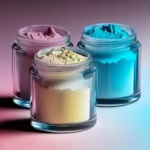
Fluxed magenta for pink, purple and violet tones. Fluxed red for strong reds and oranges. Unfluxed magenta for the widest gamut and high firing stability. Unfluxed red for strong reds at high temperature. Glass toners for glass. Send us your ware and kiln and we will pick one.
Will it work with my ceramic or glaze?
Usually. INEQS knows a wide range of tile and porcelain suppliers and can estimate what will work. If you make your own ware, run a few trials before production; the toner range is wide enough that we almost always find a match.
What is the firing curve?
It depends on the set, the ware and the kiln. As a guideline: unfluxed red set 860 to 1,150 °C, unfluxed magenta set 880 to 1,000 °C, fluxed magenta set 880 to 900 °C, fluxed red set 805 to 830 °C. Ventilate the kiln while heating to about 420 °C.
Why do colours change during firing?
Ceramic pigments only develop their final colour in the kiln. Temperature, cycle, glaze and substrate all shift the result, which is why ICC profiling matters on a production line.
Do I need special software?
Basic printing works without RIP software. Professional users gain from colour management and a custom ICC profile: better accuracy after firing, less waste and repeatable production. See software and colour management.
Can I use my own printer?
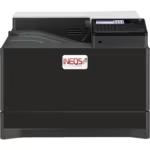
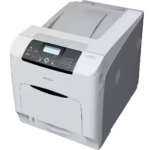
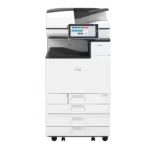
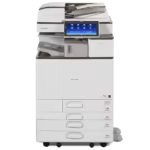
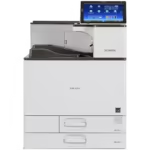
Some colour laser engines can be converted. Send us the model and serial number.
Do room conditions matter for the printer?
Yes. Keep the printer at 20 to 25 °C and 40 to 60% humidity and avoid sudden changes; both affect developer life and print quality.
How many decals can I produce per day?
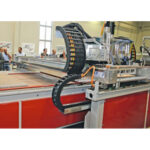
It depends on the printer, the format and the workflow. A desktop system suits custom work and short runs; an industrial system produces hundreds of decal sheets a day.
Can I start with a small system and upgrade later?
Yes. Many customers begin with a compact printer and move to a production system as demand grows. The toner, the software and the workflow carry over.
Do you sell kilns, laminators or screen-printing machines?
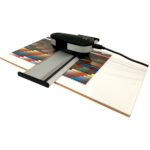
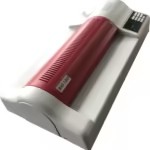
Yes, on request, alongside printers and consumables. See equipment.
Do I need previous experience?
No. Most customers start with none. INEQS provides training, technical support and workflow guidance so you reach professional results quickly.
Is there a minimum order for the print service?
One A4 sheet. New customers can request test prints before ordering in volume. See the decal print service.
Do you provide technical support?
Yes. Remote and on-site support, ICC profiling, colour management, installation and operator training, anywhere in the world. See technical service.
How fast do you respond to a technical problem?
Over 80% of problems are solved within one working day (Mon to Fri, 08:00 to 17:00 CET), usually within a few hours, remotely or on site.
What makes INEQS different from other suppliers?
INEQS makes both the printer and the toner, so one team owns the whole chain from file to fired ware. Most customers arrive after struggling with colour matching, firing or printer setup somewhere else. Honest advice comes first, even when it does not lead to a sale.
Still stuck? Send us the details and an engineer will answer. Over 80% of technical problems are solved the same working day.