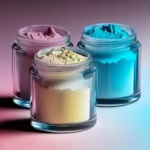

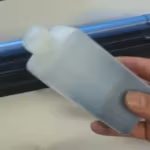
INEQS Liquid Cover Coat is used to protect ceramic decals during handling, transfer and firing.
It forms a flexible transfer film that allows safe application of ceramic decals onto ceramic, porcelain, glass and enamel surfaces.
Technical Information
- Ready-to-use liquid coating
- Brush, roller or dip application
- Fast drying
- Flexible transfer film
- Clean burnout during firing
- Suitable for fluxed and unfluxed toner systems
- Compatible with ceramic and glass decals
Applications
- Tableware
- Porcelain Decoration
- Glass Decoration
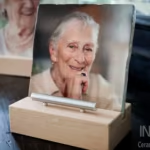
- Memorial Ceramics
- Industrial Decals
Provides reliable handling and consistent decal performance.
When to choose liquid cover coat
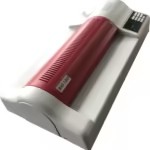
Liquid cover coat suits small and medium runs, odd sizes and decals that a laminator cannot take. It needs no machine and no screen: the coat is applied by brush, roller or dip, dries quickly and forms a flexible film that follows curved and uneven ware during transfer. For large daily volumes, lamination or screen printing is faster and more consistent.
How to apply it
- Let the printed decal cool and settle before coating
- Apply an even layer that covers the whole printed area with a small margin around it
- Avoid thin spots and heavy runs: thin spots tear during soaking, heavy runs slow the burnout
- Let the coat dry fully before soaking the decal
Fluxed and unfluxed toner
The cover coat carries the image and burns out cleanly in the kiln. What it cannot do is replace flux: unfluxed toner always needs a fluxed coating to fuse into the glaze, while fluxed toner can be finished with lacquer only for a border-free result. Tell INEQS which toner set you use and we will confirm the right combination. During firing, ventilate the kiln up to about 420 °C so the coating burns out without marking the surface; see how to fire ceramic decals.
Liquid cover coat compared
Lamination gives the most repeatable film with the least operator influence and suits daily production. Coating spray is quickest for one or two decals and needs no brush or roller. Liquid cover coat sits between them: it needs no machine, handles odd sizes and shapes, and lets you build a slightly heavier film where a large or curved decal needs extra strength during transfer. Screen printing remains the cheapest per decal at medium and high volume. See all consumables, or ask INEQS which method fits your run size.